

JUDE BENHALIM: MADE IN CAIRO
Jude Benhalim’s jewelry begins with material.
In the brand’s Cairo workshop, metal is shaped and finished by hand. Resin is mixed, formed, dyed and polished individually. Stones are set one by one. The process leaves room for variation, the small differences that make a handmade object feel, unmistakably, handmade.
Benhalim founded the label with her mother and business partner, Rana El Azm, in 2011, when she was just 17. What began with a high-school design project and a small collection of beaded jewelry sold at a charity event grew into one of Cairo’s most recognizable contemporary jewelry houses.
The vocabulary has evolved considerably since then, but some things have remained constant: sculptural form, unexpected combinations of materials, and a fascination with the line between jewelry and object.
“My designs are inspired by modern art and architecture, sharp edges and abstract constructions.” — Jude Benhalim, Harper’s Bazaar Arabia, 2017.
On material
Resin has become one of the signatures of Jude Benhalim’s work.
Rather than treating it as an imitation of something precious, the studio uses the material on its own terms: translucent, saturated, sometimes oversized and deliberately juxtaposed with metal. Each resin component is mixed, shaped, dyed and polished by hand in Cairo, allowing the studio to create its own colors, forms and finishes.
The brand’s fashion jewelry commonly pairs brass finished in 21k gold or rhodium with custom resin and semi-precious stones, while its fine-jewelry pieces use 925 sterling silver. The contrast is part of the language — metal against resin, weight against translucency, the polished beside the raw.
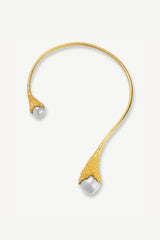
The Frost Necklace is a particularly clear example. Its asymmetrical construction places two exaggerated teardrop-shaped resin stones against a gold-plated wire form, finished with textured metal cones. The piece is made from 21k gold-plated brass and custom resin.
No two handmade pieces are entirely identical.
On making
There is an important distinction between something designed around the region and something designed within it.

Jude Benhalim’s pieces are designed and handcrafted in Cairo. The brand describes its process as deliberately slow and hands-on: drawing, sculpting, forming, polishing and assembling take place through its workshop team, with techniques refined over years of working with the same materials.
That physicality is visible in the finished work. The jewelry is bold without relying on literal heritage motifs to establish where it comes from. Earlier collections have drawn from architecture, Arabic calligraphy, urban landscapes and the tension between traditional Egyptian jewelry and contemporary art.
It is jewelry from Cairo that is allowed to be contemporary.
On Los Angeles
That distinction is part of why Jude Benhalim belongs at HOUSE OF MENA.
Our boutique was created to bring contemporary creative work from the Middle East and North Africa into Los Angeles on its own terms- alongside coffee, food, art, fashion, objects and the everyday culture surrounding them. Jude Benhalim is part of HOUSE OF MENA’s inaugural designer assortment alongside a wider generation of established and emerging MENA brands.
For us, the point is not nostalgia for a version of the region frozen in time. It is access to what is being made there now.
A piece conceived in Cairo can sit in Los Angeles without needing to explain itself. It can be sculptural, strange, beautiful, collectible - and simply good design.
That might be the most compelling thing about Jude Benhalim’s work.
It carries where it comes from without being confined by it.


